GHMJ (Global Health Management Journal)

About the Journal

ISSN 2580-9296 (ONLINE)

GHMJ (Global Health Management Journal) is an open-access, triannual, peer-reviewed, online journal with a strong emphasize on health and applied science in health. Authors are welcomed to submit original research paper, systematic review, best practice, perspectives, and photo essay in health-related topics to our journal. 

Registered since 19 June 2017 under the National Research and Innovation Agency of Indonesia , the journal is published by Yayasan Aliansi Cendekiawan Indonesia Thailand, also known as Indonesian Scholars' Alliance, based in Semarang, Central Java, Indonesia.

To expand the user's engagement, the journal is indexed by Directory of Open Access Journal (DOAJ)Google ScholarOCLC WorldCat, and Portal Garuda Indonesia Publication Index. The metadata is archived at the Index Copernicus International. The last publication is updated at JournalTOCs and Scilit (a comprehensive and open-access scholarly database developed and maintained by MDPI). All our published papers have been stored in Semantic Scholar and OpenAlex, significantly enhancing their visibility and citation potential through AI-driven discoverability. 

Everyone is invited to submit an article at any time (no deadline for submission). Once the article is editorially accepted, it will be published as Online First before inclusion in an issue. GHMJ does not receive articles via email. For more information regarding paper submission and publication policy, please visit our guidelines For Author in our website. We also invite scholars and practitioners to join us as peer review with criteria as stated in our For Peer Reviewers page. 

We are a member of Crossref, therefore, Authors of GHMJ (Global Health Management Journal) can claim their published articles at Base Search and connect it with their ORCID. Also, visit GHMJ's online catalogs from universities and librarian overseas. Authors may use this manuscript template when preparing their paper (check submission checklist).

-------------------------------------------------------------

The Global Health Management Journal (GHMJ) welcome high-quality, original research articles, reviews, photo essays, and case studies that contribute to advancements in the following categories:

  1. Health Promotion for Children, Youth, and Families,
  2. Health Services, Media, Management, and Policy,
  3. Health Education, Intervention, and Systems,
  4. Epidemiology, Nutrition, Health Behavior, and Public Health,
  5. Women's, Nursing, and Midwifery Health,
  6. Mental Health and Well-being,
  7. Environmental, Occupational Health, and Safety,
  8. Applied Science Related to Health Development,
  9. Medical Technology and Applications.

The Global Health Management Journal (GHMJ) does not receive articles via email, but only through the OJS System. For more information regarding paper submission and publication policy, please visit our guidelines For Author in our website. We also invite scholars and practitioners to join us as peer review with criteria as stated in our For Peer Reviewers page. 

As 10 January - 3 March 2026 (Updated on doi.org/10.35898/ghmj-911331)

  • Acceptance Rate   : 49 %
  • Days to First Editorial Decision  : 5 days
  • Days to accept  : 56 days

================================================================

VOL. 9, NO. 2 (2026): ONLINE FIRST

This Online First edition is featuring selected and double-blind peer-reviewed papers for the upcoming edition of Global Health Management Journal : Vol. 9, No. 2 (2026). Everyone is invited to submit an article at any time (no deadline for submission). Once the article is editorially accepted, it will be published as Online First before inclusion in an issue. 


PERSPECTIVES

Data Without Dignity? A Critical Perspective on How Educational Assessment Systems Overlook the Financial and Safety Realities of Women Learners

  • Dr. Moses Mhide Kpum, & Prof. Velisiwe Gasa

RESEARCH ARTICLES

Peroxisome Proliferator-Activated Receptor Gamma (PPARG2) rs3856806 Gene Polymorphism as a Risk Factor for Type 2 Diabetes Mellitus

  • Fauzaan Azhar Rizqulloh, S.Ked., Donny Nauphar, M.Si.Med., & dr. Tiar Masykuroh Pratamawati, MM., M.Biomed.

Correlation Between Cardiovascular Endurance and Changes in Blood Pressure in Employees of Universitas Swadaya Gunung Jati, Cirebon, Indonesia

  • Ajeng Sanitaquin, S.Ked., dr. Kati Sriwiyati, M.Biomed, & dr. Sherly Cancerita, M.Ked (Cardio), Sp. JP, FIHA.

Attributes Descriptions among the Medical Lecturers in Implementing the Problem-Based Learning (PBL) Based on the Onion Model Theory

  • Alya Maharani, S.Ked, dr. Vivi Meidianawaty, M.Med.Ed, & dr. Tissa Octavira Permatasari, M.Med.Ed

In Silico Structural Analysis of Malaria - Associated Single Nucleotide Polymorphisms in Human Genes TLR4, ICAM1, and IL22

  • dr. Venty Muliana Sari Soeroso, M.Si.Med., M.Sc., Agri Lesmana, S.Ked., dr. Alfa Januar Krista, M.Kes,Sp.OT, FICS, AIFO-K., & Dr. Arief Budi Witarto B.Eng., M.Eng.

Climate Variability, Catastrophic Health Expenditure, and Non-Communicable Disease Outcomes in Nigeria

  • Jude Igyo Ali, Ph.D., & Prof. Patricia Lindelwa Makoni

Psychoactive Substance Uses and Risky Sexual Behaviors among Street-Connected Children in Kinshasa, Democratic Republic of Congo: Prevalence and the Associated Factors

  • Rodriguez Kambamba Mboma, MD, MPH., Reagan Moluantuan Ndwaya, MD, MPH., Dan Nkelenda Mulumba, MD, MPH., Rodrigue Kumbu Khonde, MD, MPH., Joseph Wamu Oyombo, MD, MPH., Dieudonné Mukendi Mpunga, MD, MPH, PhD.

REVIEW

Entrepreneurship, Innovative Education, and Cross-Sector Collaboration as Catalyst for Sustainable Health System in Nigeria

  • Dr. Isaac Msughter Peter, & Prof. Velisiwe Gasa

Announcements

June/July 2026 Special Issue: Climate Resilience, Population Health & Sustainable Futures

2026-06-04

"Climate Resilience, Population Health, and Sustainable Futures"

Once the article is editorially accepted, it will be published as Online First before inclusion in an issue.

----------------------------------------------------------------------------

Why This Topic Matters

  • Climate change is reshaping population health” reminds us climate change affects every stage of life and every sector of society. Addressing climate-related health challenges requires interdisciplinary collaboration, robust evidence, and practical solutions. 

From devastating floods and coastal erosion to prolonged heatwaves and deteriorating air quality, the consequences of climate change are becoming a defining challenge for health systems and populations alike. This Special Edition seeks to explore how climate-related challenges influence population health and how communities, health systems, researchers, policymakers, and practitioners can work together to develop sustainable responses.
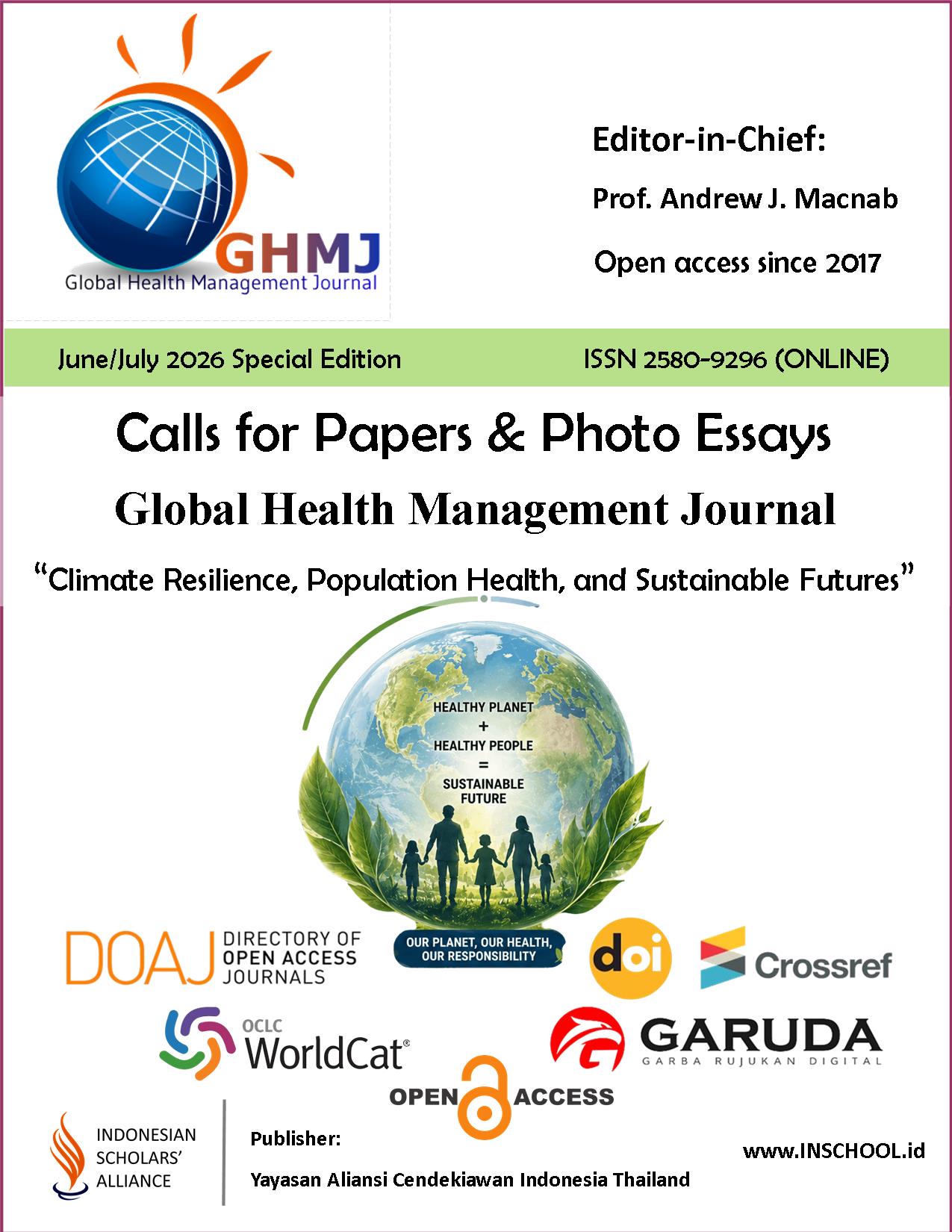
Read more about June/July 2026 Special Issue: Climate Resilience, Population Health & Sustainable Futures

Current Issue

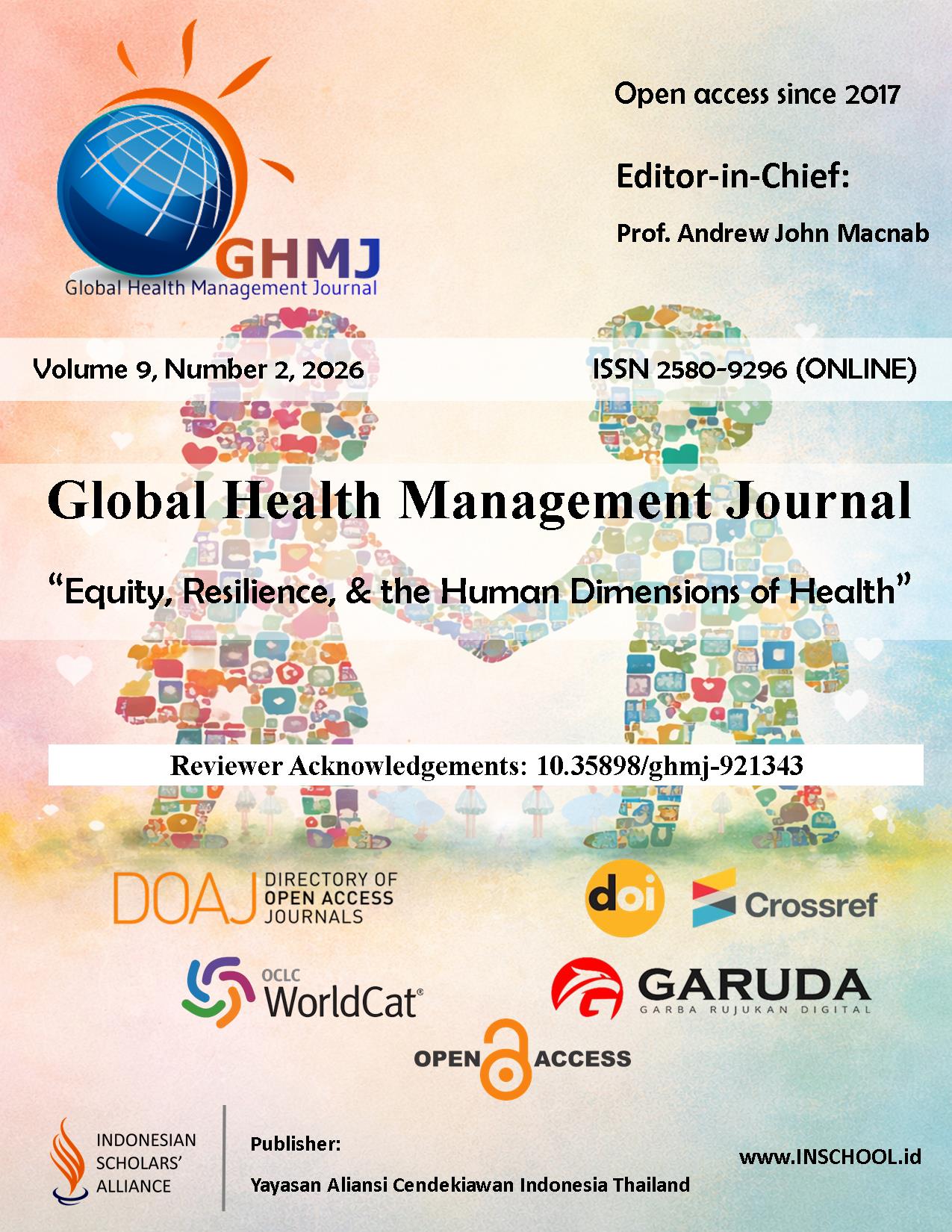
Vol. 9 No. 2 (2026)
					View Vol. 9 No. 2 (2026)

Equity, Resilience, & Human Dimensions of Health

The issue of the Global Health Management Journal (Vol. 9, No. 2, 2026) brings together contributions that examine how health outcomes are shaped by the social, educational, environmental, and biological realities of people's lives. Kpum and Gasa (2026) challenge educational assessment systems to recognize the financial and safety barriers faced by women learners, while Mboma et al. (2026) highlight the urgent health and social risks experienced by street-connected children in Kinshasa. At a broader systems level, Ali and Makoni (2026) demonstrate how climate variability can increase catastrophic health expenditure among households affected by non-communicable diseases, while Peter and Gasa (2026) discuss how entrepreneurship, innovative education, and cross-sector collaboration can strengthen health system sustainability.

The issue also features research from Faculty of Medicine, Universitas Swadaya Gunung Jati, processed under Special Edition commitment, that advances scientific understanding and health education. Rizqulloh et al. (2026) examine the association between the PPARG2 rs3856806 polymorphism and type 2 diabetes mellitus, while Soeroso et al. (2026) investigate malaria-associated genetic variants through computational structural analysis. In medical education, Maharani et al. (2026) provide insights into lecturer attributes that support student-centered problem-based learning, and Sanitaquin et al. (2026) contribute evidence on cardiovascular endurance and blood pressure among university employees.

Together, these articles reinforce the importance of integrating social equity, environmental resilience, educational development, and scientific innovation in addressing contemporary global health challenges.

We extend our sincere appreciation to the authors for sharing their valuable research and to the reviewers whose expertise and thoughtful feedback helped strengthen every manuscript published in this issue. The full list of reviewers is available in the Reviewer Acknowledgements document: https://doi.org/10.35898/ghmj-921343

Published: 2026-03-12

Perspectives

Research Articles

Review

Reviewer Acknowledgements

View All Issues

FOCUS AND SCOPES

GLOBAL HEALTH MANAGEMENT JOURNAL (GHMJ) is published by Yayasan Alliansi Cendekiawan Indonesia Thailand, also known as Indonesian Scholars' Alliance, based in Semarang, Central Java, Indonesia. Under InSchooL as an education corporation, GHMJ serves to accommodate health scholars and practitioners to publish innovative and good-quality papers as strong evidences to support policy makers in developing health program. The journal focuses on health field with strong preference (but not limited) on public health in general, maternal and child health, nursing, midwifery, sexual and reproductive health, public health nutrition, environmental health, occupational health and safety, health promotion, health economics in South East Asia and other regions. Applied science in health also becomes one of our priority, especially in the field of health information and technology, innovation in health, and development of devices, medicines, vaccines, procedures and systems developed to solve a health problem and improve quality of lives.

Authors may use this manuscript template when preparing their paper.